California Personnel File Checklist
Labor Code section 1198.5 gives every current and former California employee the right to inspect and copy their personnel file. File a record in the wrong place and it shows up in the next inspection or subpoena. This one-page checklist sorts every employment record into the right file and lists the retention minimum for each, updated for SB 513, effective January 2026.
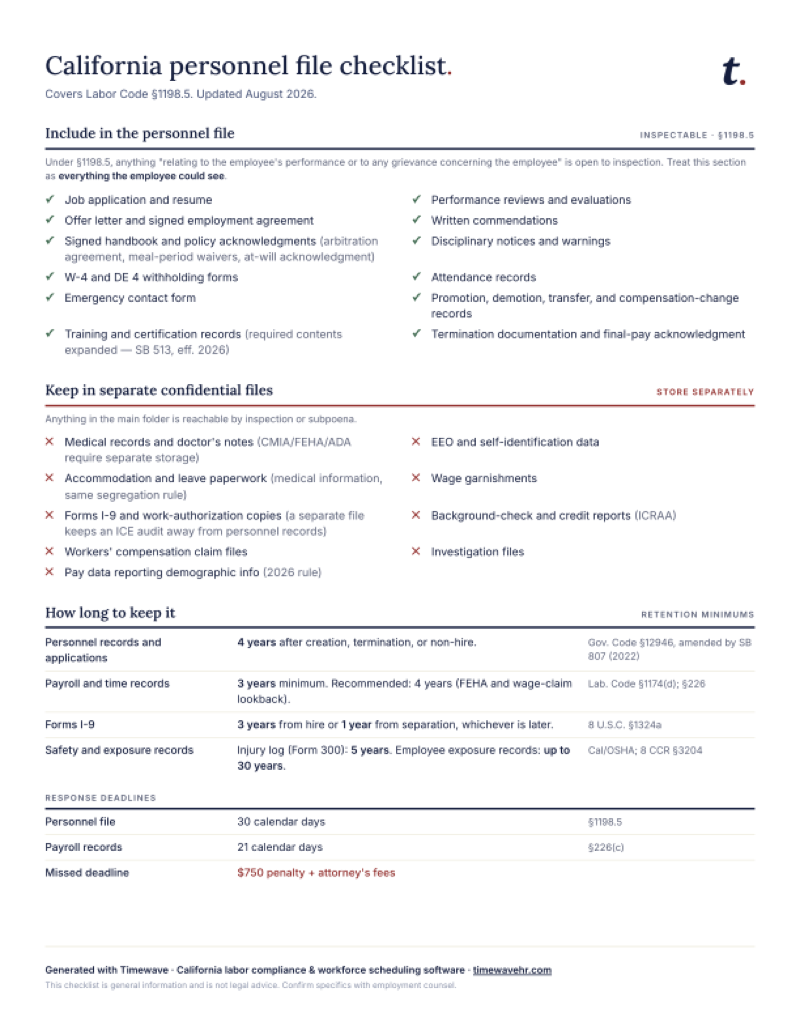
Filing rules. Retention table. Request deadlines.
Print it and keep it next to the filing cabinet.
For the full 2026 rules, including SB 513's required training-record contents, see What Belongs in a California Personnel File in 2026. If a records request signals a wage dispute, estimate exposure with the California Meal Penalty Calculator.
What goes in the personnel file
Section 1198.5 opens to inspection anything “relating to the employee's performance or to any grievance concerning the employee.” The working rule: the main file holds everything the employee could see. That includes:
- Job application, resume, offer letter, and the signed employment agreement
- Signed handbook and policy acknowledgments, including arbitration agreements and meal-period waivers
- Performance reviews, written commendations, and disciplinary notices
- Attendance records
- Promotion, demotion, transfer, and compensation-change records
- Training and certification records, with required contents expanded by SB 513 effective January 2026
- Termination documentation and the final-pay acknowledgment
What must be stored separately
Anything in the main folder is reachable by inspection or subpoena, so records with their own confidentiality rules belong in separate files:
- Medical records, doctor's notes, and accommodation or leave paperwork (CMIA, FEHA, and the ADA require separate storage)
- Forms I-9 and work-authorization copies (a separate file keeps an ICE audit away from personnel records)
- Background-check and credit reports (ICRAA)
- EEO and self-identification data, and pay data reporting demographic information (2026 rule)
- Wage garnishments
- Workers' compensation claim files and investigation files
Retention minimums and response deadlines
The retention floors, by record type:
- Personnel records and applications: 4 years after creation, termination, or non-hire (Gov. Code §12946, amended by SB 807)
- Payroll and time records: 3 years minimum, with 4 years recommended to cover the FEHA and wage-claim lookback (Labor Code §1174(d), §226)
- Forms I-9: 3 years from hire or 1 year from separation, whichever is later
- Safety records: 5 years for the Form 300 injury log, and up to 30 years for employee exposure records (Cal/OSHA)
Two clocks run on a records request: 30 calendar days to provide the personnel file (§1198.5) and 21 calendar days for payroll records (§226(c)). Missing either deadline costs a $750 penalty plus attorney's fees.
What are the California personnel file rules?
Labor Code §1198.5 gives current and former employees the right to inspect and copy their personnel records on a 30-day clock, with a $750 penalty for missed deadlines.
What belongs in a personnel file in California?
Labor Code section 1198.5 opens to inspection any record relating to the employee's performance or to any grievance concerning the employee. In practice that means the job application, offer letter, signed policy acknowledgments, performance reviews, disciplinary notices, attendance records, compensation-change records, training records, and termination documentation. Records with their own confidentiality rules, such as medical records and Forms I-9, are kept in separate files.
Can a former employee request their personnel file?
Yes. Section 1198.5 covers current employees, former employees, and their authorized representatives, though an employer only has to honor one request per year from a former employee. A former employee terminated for violating a policy on harassment or workplace violence can be offered inspection away from the workplace, or a mailed copy, instead of an on-site visit.
Is the employee handbook part of the personnel file?
The signed acknowledgment is; the handbook itself is not. Acknowledgment pages, arbitration agreements, meal-period waivers, and at-will acknowledgments are records the employee signed, so they belong in the personnel file and are open to inspection. Separately, Labor Code section 432 entitles employees to a copy of any document they signed relating to obtaining or holding employment.
What can an employer withhold from inspection?
Section 1198.5(h) excludes three categories: records relating to the investigation of a possible criminal offense, letters of reference, and ratings, reports, or records that were obtained before employment, prepared by identifiable examination committee members, or obtained in connection with a promotional examination. Employers may also redact the names of nonsupervisory employees that appear in the file. Everything else relating to performance or grievances must be produced.
What changed in 2026?
Two things. SB 513 expanded what training and certification records must contain, including the training provider, the duration and completion date, and the core competencies or certifications earned, so employees can carry proof of skills between jobs. Separately, demographic information collected for California pay data reporting must now be kept apart from the personnel file.
How long must personnel records be kept?
Four years after the record was created, after termination, or after a non-hire decision, under Government Code section 12946 as amended by SB 807. Payroll and time records carry a three-year statutory minimum under Labor Code section 1174(d), but four years is the safer retention period because FEHA claims and wage claims with an Unfair Competition Law cause of action can reach back that far.
A §1198.5 request is often the first step in a wage claim. The records that decide those cases are time, attendance, and break records. Timewave retains them automatically and exports them on request.